
Every client conversation this quarter has started the same way. “We need to show up in ChatGPT.” “Our competitor got cited in an AI Overview and we didn’t.” “Can you get us into the AI results?”
Good news: yes. There’s a real, data-backed formula for this, and it’s simpler than the industry wants you to believe. The bad news is for whoever sold you that “AI SEO package” last month, because it’s probably just a backlink package wearing a trench coat, and it’s optimizing for the wrong number.
The Problem with Traditional Backlink Packages in AI SEO
The villain here is the backlink hustle, still trying to cash the same check
For twenty years, the SEO industry ran on one gospel: get links, get rankings, get traffic. That gospel isn’t wrong, exactly. It’s just being repackaged and sold to panicked clients as an “AI visibility strategy” without anyone bothering to check whether it still applies. It doesn’t. And now, finally, there’s a clean dataset to prove what the actual formula looks like.
Ahrefs pulled correlation data across 75,000 brands and looked at what actually predicts whether a brand gets cited in AI Overviews. The results are great news if you want a real playbook, and very bad news if your current one is still invoicing clients for Domain Rating improvements as the AI play.
What the Data Says: Ranking AI Search Citation Signals
Brand Mentions vs. Backlinks: Key Correlations
Ahrefs ran the numbers across 75,000 brands to find out which signals actually predict AI citations. The short version: the things most agencies sell hardest are the things that matter least.
The numbers, for the people in the back:
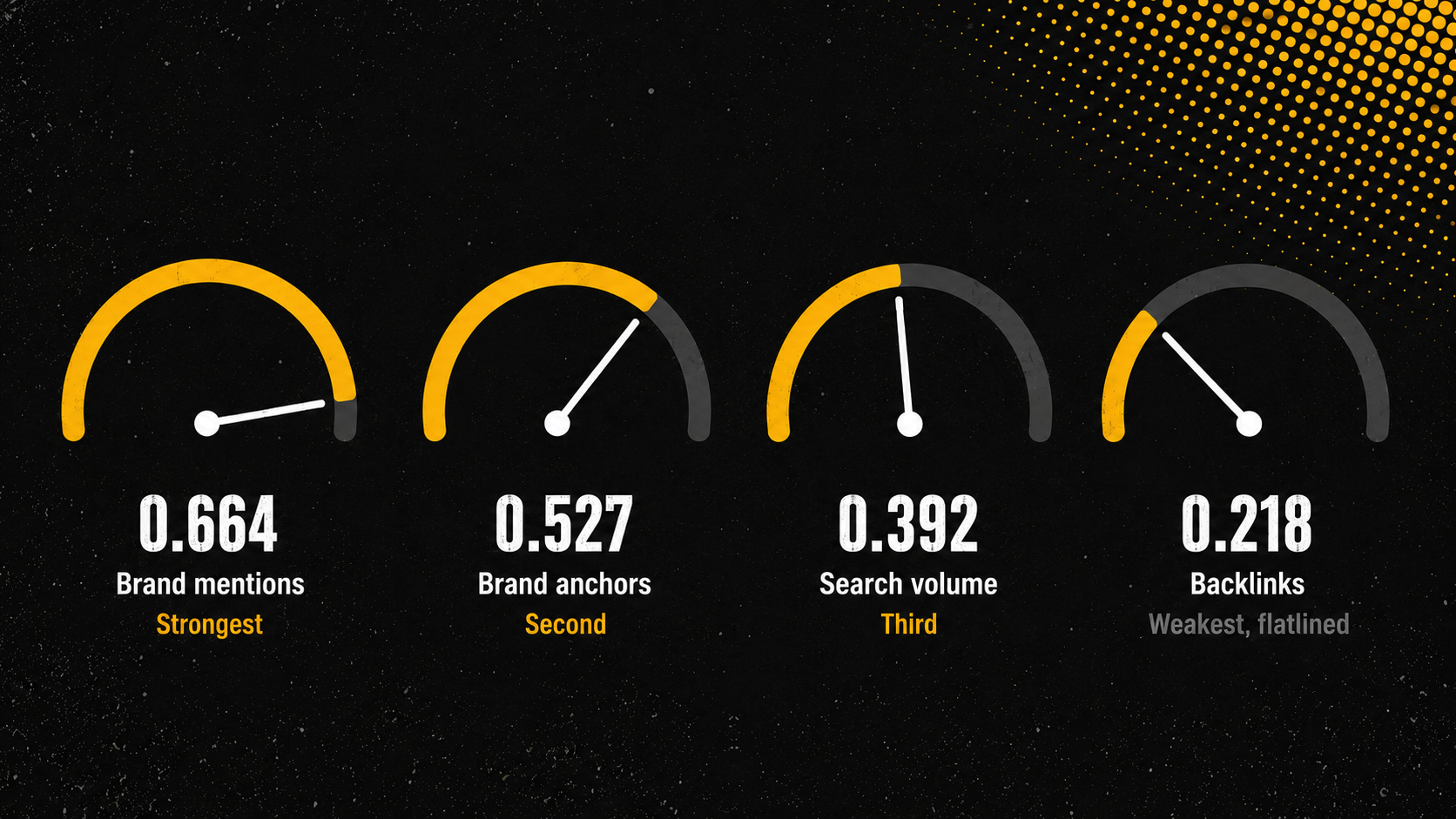
- Branded web mentions: 0.664 correlation with AI Overview visibility. Strongest predictor, not close.
- Branded anchor text: 0.527. Second place.
- Brand search volume: 0.392. Third.
- Backlinks: 0.218. Dead last, and not by a little.
Do the math. Mentions aren’t just slightly ahead of backlinks, they’re nearly three times stronger as a predictor. The metric your last agency built its entire pitch deck around is the weakest signal on the board.
And it gets worse for the link-building crowd. A follow-up analysis extending into ChatGPT and Google AI Mode found YouTube mentions outperforming everything, correlating around 0.737 with AI brand visibility. The pattern holds everywhere researchers look: the strongest signals live off your website, in places you don’t control and can’t buy your way into with a guest post and a prayer.
Ranking vs. Getting Cited: Two Different Games
Ranking gets you in the room. The formula gets you cited.
Here’s the part that should really sting if you’ve been optimizing purely for page one. Backlinks still move traditional rankings, but they’re a weak predictor of whether an AI system cites you. Ranking well and getting cited by an AI system are two different games with two different scoreboards, and most brands are still only playing one of them.
Third-party research backs this up from another angle entirely. Independent studies looking at AI Mode citations found the majority came from pages that weren’t even sitting in the traditional top 10. Ranking is the entry fee. It’s not the ticket.
Meanwhile, the traffic incentive to keep chasing rankings alone is quietly evaporating. Ahrefs found that Google’s AI Overviews now cut average clickthrough rates on top-ranking pages by 58%, up sharply from where that number sat just eight months earlier. You can rank number one and still watch the click go to a summary box instead of your site. Congratulations on the trophy nobody sees.
Earned Coverage: What Actually Moves the Needle in AI Search
So what actually moves the needle? Being talked about, not just linked to
This is where it gets philosophically inconvenient for anyone who wants a checklist instead of a strategy. You can’t manufacture brand mentions the way you can manufacture backlinks. There’s no marketplace for “500 authentic mentions, delivered in 30 days,” and if someone offers you one, run.
What the data actually points to is unglamorous and slow: earned coverage, real conversation, a brand that people and publications talk about because there’s something worth talking about. Independent tracking has found the large majority of AI citations pulling from earned, non-brand-owned sources, not owned content and not paid placement. AI systems are grounding their answers in what the open web already says about you, not in what you paid someone to say about you.
That’s not a loophole. That’s the whole shift. The AI didn’t invent a new ranking factor to game. It just started listening to the conversation instead of counting the links.
The Playbook: How to Build an AI Search Strategy That Works
The formula, in practice
Skip the panic-buy of an “AI SEO audit” that’s secretly a backlink report with new branding. Here’s what actually works, in order:
- Audit Your Unlinked Brand Mentions: Audit what the internet already says about you, not just where you sit in search results. If nobody’s mentioning your brand outside your own site, that’s the gap, not your Domain Rating.
- Earn Coverage Across External Platforms & Video: Build content that earns mentions, on sites and platforms you don’t own. Branded anchors and organic mentions in the pieces other people write about you matter more than the links you place yourself.
- Maintain SEO Fundamentals Without Treating Rankings as the Finish Line: Keep the SEO fundamentals, because ranking still gets you into the candidate pool. Just stop treating it as the finish line.
- Track Leading Indicators: Search Volume & Branded Anchors: Track brand search volume and branded anchor growth as leading indicators, not vanity metrics. They’re doing more predictive work than your backlink count.
None of this is a quick win, but it’s not a mystery either. It’s a formula, and once you know which signals actually carry weight, the work gets a lot more targeted than “publish more, link more, hope.”
That’s the part we’ve already figured out. We build the brand mention and SEO strategy that maps to how AI systems actually choose who to trust, ranking fundamentals included, backlink obsession left behind.
