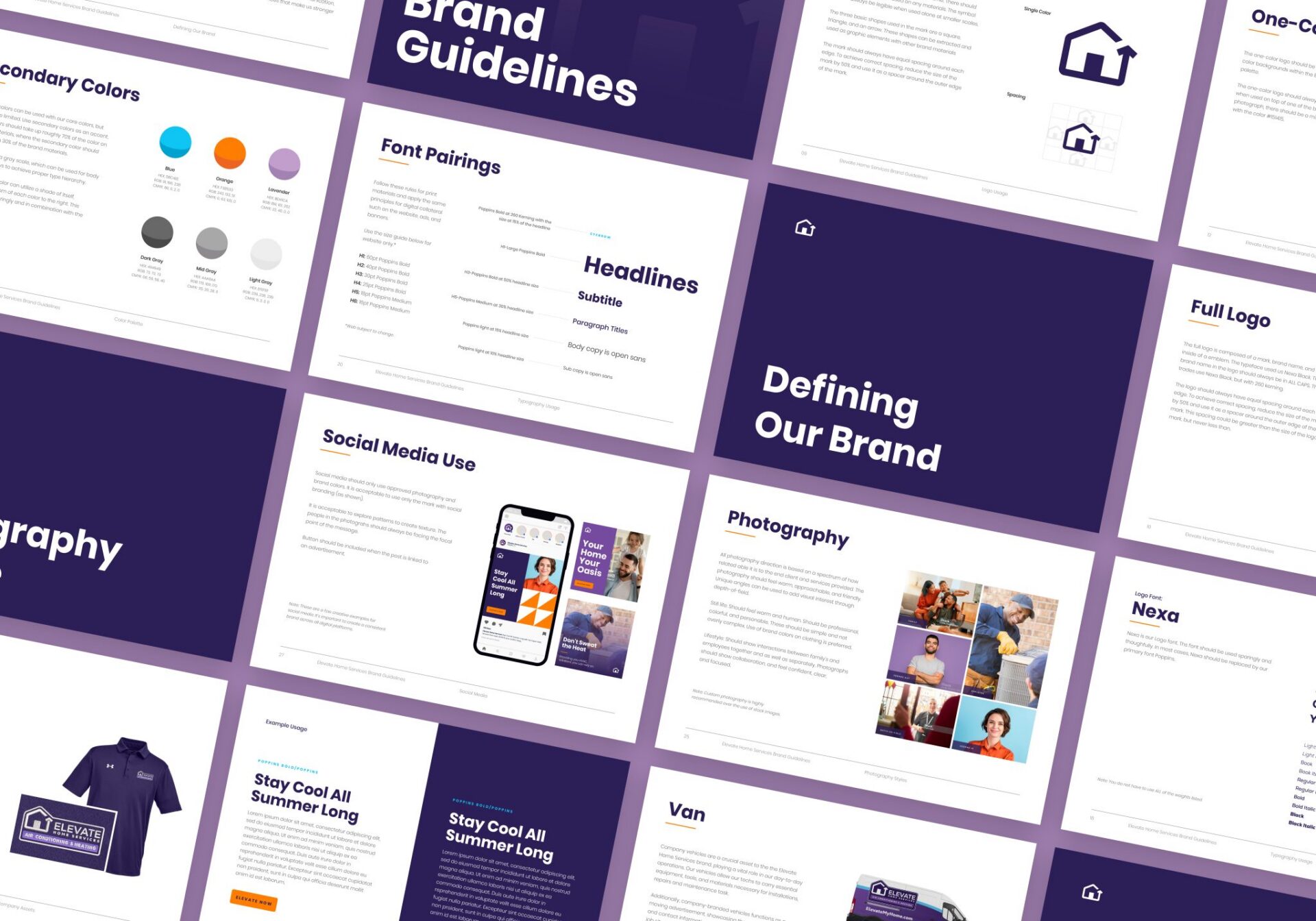
Most small businesses do not have a branding problem. They have fourteen versions of the logo, three fonts nobody chose, and a sales deck someone built at midnight before the big meeting.
Small business branding is not about making more things. It is about deciding how you want to be known, making a short list of things that say it well, and using them the same way everywhere a customer sees you. The companies that look established are rarely the ones spending the most on design. They are the ones that stopped improvising.
This guide covers what that short list is, what a branding package should include, who should do the work, what it costs, and how to keep it from drifting.
Consistency looks expensive. Improvising looks small.
In this guide:
- What small business branding actually is
- Why small business branding matters
- What a small business branding kit includes
- Start with an identity system, not a logo
- Small business branding for B2B sales
- Small business branding on your website
- What a small business branding package should include
- Who should do your small business branding
- How much small business branding costs
- How to brief a designer
- Files to get from your designer
- What to skip for now
- How to keep your branding consistent
- What small business branding looks like in practice
- FAQ
What small business branding actually is
Branding is what people think and feel about your company. Your brand identity is the visual system that shapes it: logo, colors, typography, imagery, and the rules for using them. For a small business, branding means choosing how you want to be known and then making every touchpoint, from the website to the invoice, say that one thing.
The two get mixed up constantly, and the difference matters when you are spending money. We wrote up the difference between branding and identity design if you want the longer version.
A brand is the promise. The identity is how you keep it recognizable.
Why small business branding matters
Consistency pays. In the Lucidpress State of Brand Consistency study, which surveyed more than 200 organizations, companies reported that consistent branding can increase revenue by up to 33 percent. The same study found that 81 percent of companies still deal with off-brand content. Those are self-reported survey numbers, but the pattern matches what we see: most brands do not fail on design, they fail on discipline.
For a small business the effect is sharper. A buyer who has never heard of you judges your size, stability, and price from what they see before anyone talks to them. Mismatched materials make you look smaller than you are, and looking small costs you deals you never hear about.
Nobody tells you they passed because your deck looked homemade. They just pass.
What a small business branding kit includes
Strip away the nice-to-haves and a growing business needs six pieces. Everything else is optional until these are done:
- A brand identity system: logo, color palette, typography, imagery style, and the rules for using them.
- A website that matches the identity, not a template that fights it.
- Sales collateral: a one-pager, a few case studies, and a proposal template your team actually uses.
- A presentation template, so every pitch looks like the same company made it.
- Social media templates that let anyone on the team post without inventing a new look.
- Print and signage, but only where customers physically see it: the office, the truck, the trade show booth.
If a piece of design is not on this list, ask who it is for before you pay for it.
Start small business branding with an identity system, not just a logo
The most common small business branding mistake is buying a logo and calling it a brand. A logo is one mark. An identity is the system around it that makes a one-pager, a website, and a trade show banner look like they came from the same company. Without the system, every new piece gets designed from scratch, and each one drifts a little further from the last.
A logo without a system is a signature on a letter nobody else can read.
Small business branding for B2B sales
For a business that sells to other businesses, the branding that matters most is what your buyer sees during the decision: the deck in the first meeting, the one-pager forwarded to their boss, the case study that answers “have you done this before?” These pieces get judged by people you will never meet, in rooms you are not in. A clean, consistent sales kit does quiet work for you there. A mismatched one raises doubts before anyone reads a word.
Your buyer judges your deck before they judge your price.
Small business branding on your website
Your website is where the brand either holds together or falls apart. It needs the same colors, type, and imagery style as everything else, plus the pieces only a site needs: icons, section graphics, and photography that looks like your actual business instead of stock handshakes. Good web design and development treats the identity system as the rulebook, not a suggestion.
If your website and your business cards look like two different companies, prospects notice. They just do not tell you.
What a small business branding package should include
“Branding package” can mean anything from a logo and a business card to a full rebuild. Before you compare quotes, check what is actually in the box. A solid small business branding package includes:
| Deliverable | What you get | Why it matters |
|---|---|---|
| Positioning basics | Who you serve, what you say, and how you sound | Gives every design decision a reason |
| Logo suite | Primary logo, secondary and icon versions, one-color versions | Works everywhere from a favicon to a billboard |
| Color and typography | Defined palette with codes, licensed fonts, usage rules | Stops the three-fonts-nobody-chose problem |
| Brand guidelines | A short guide covering all of the above plus do and do not examples | Lets anyone use the brand correctly without asking |
| Templates | Deck, one-pager, proposal, and social templates | Turns the identity into everyday output |
| Sales collateral (optional) | Designed one-pager and case study layouts | Puts the brand where B2B deals are decided |
| Website design (optional) | A site built on the identity system | Your most-seen brand touchpoint |
A package that ends at a logo and a business card is a starter kit, not a brand.
Who should do your small business branding?
Each option fits a different stage and budget. Here is how they compare:
| Option | Typical cost | Best for | Watch out for |
|---|---|---|---|
| DIY (Canva and similar) | Low monthly software cost | Everyday posts and documents inside an existing system | Without a system, this is how brands drift |
| Freelancer | Per project | A single, well-defined piece, like a logo refresh | Managing several freelancers across brand, web, and sales |
| In-house designer | Salary plus benefits (BLS median pay: $61,300) | High, steady volume once the brand is set | Hiring one person to be strategist, designer, and producer |
| Design subscription | Flat monthly fee | Ongoing production at predictable cost | Strategy is usually not included |
| Agency | Project fee or retainer | Building the system and connecting brand, web, and sales | Paying agency rates for work templates could handle |
Salary figure: the U.S. Bureau of Labor Statistics reports a median annual wage of $61,300 for graphic designers as of May 2024, before benefits and overhead. The smart split for most small businesses is to pay a professional for the system, then let templates, and eventually a design retainer or in-house hire, handle the volume.
The mistake is using the cheapest option for the foundation and the most expensive one for the details.
How much does small business branding cost?
Prices vary with scope, experience, and region, but the ranges are fairly predictable:
| What you are buying | Typical range |
|---|---|
| Logo only | A few hundred to a few thousand dollars |
| Brand identity system (logo, colors, type, guidelines) | A few thousand dollars into the low five figures |
| Individual collateral piece (one-pager, deck template) | A few hundred to a couple thousand dollars each |
| Full branding package with website design | Low to mid five figures and up |
| Ongoing design support | Monthly retainer sized to how much you produce |
The better question is what inconsistent branding is costing you in deals that stall because you look smaller than you are.
Cheap branding gets redone. You end up paying for it twice.
How to brief a designer for your small business branding
The quality of a branding project is mostly decided before the designer opens a file. A good brief covers:
- Who you sell to, in one sentence, and who you do not.
- The three words you want customers to use about you, and the three you never want to hear.
- Two or three competitors, and what you want to look different from.
- Every place the brand has to work: website, deck, trucks, trade show booth, social, email.
- What is fixed and what is open. Keeping the name or the colors? Say so up front.
- Budget, deadline, and who has final say.
A vague brief does not save time. It just moves the confusion into the revisions.
Files to get from your designer
Plenty of small businesses pay for branding and end up with a single PNG. Before the final invoice, make sure you have:
- Vector logo files (SVG and EPS or AI) plus PNG versions with transparent backgrounds.
- Every logo variation: full color, one color, reversed for dark backgrounds, and the icon on its own.
- Exact color codes for screen and print (HEX, RGB, and CMYK or Pantone).
- Font files or links, with the licenses you need for web and print.
- The brand guidelines as a PDF.
- Editable templates in the tools your team actually uses.
If you cannot open it, edit it, or print it without calling the designer, you do not fully own it yet.
Small business branding you can skip for now
Not everything deserves budget in year one. These can usually wait:
- A full rebrand every couple of years because someone got bored. Refine the system instead.
- Brochures nobody asked for. If there is no moment in your sales process where one gets handed over, do not print it.
- Custom illustrations for every social post. Templates and good photography cover most of it.
- Branded swag before the core kit is done. A logo on a water bottle does not fix an inconsistent website.
Spending on branding is easy. Spending on the right branding is the skill.
How to keep your small business branding consistent
Good branding decays the moment people start improvising. Keeping it consistent takes a little structure:
- Write down the rules. A short brand guide covering logo use, colors, type, and tone is enough to start.
- Build templates for everything you make more than twice: decks, one-pagers, proposals, social posts.
- Give one person final say on anything customer-facing.
- Audit your materials once or twice a year and retire anything off-brand.
Consistency is not a design skill. It is a habit someone owns.
What small business branding looks like in practice
A typical small business branding engagement with us moves in four steps. First, a short discovery to pin down who you sell to and what you want to be known for. Second, the identity system: logo suite, colors, typography, and a brand guide your team can actually follow. Third, the everyday kit: deck, one-pager, proposal, and social templates built on that system. Fourth, the places buyers decide: sales collateral and, when it makes sense, a website that matches. You can see how that plays out across industries in our client work.
The finished brand is not the logo. It is every piece agreeing with every other piece.
Small business branding, done once and done right
If your materials look like they came from five different companies, the fix is not more design. It is a system, built once and used everywhere. Our branding and graphic design services start with the identity and the sales kit, then give your team templates they can use without us.